Category Archives: abilities

PSA: Your watch has no idea how many calories you burn

Your watch ⌚️ doesn’t have a clue how many calories you burn 🔥

•A study published in International Journal of Environmental Research and Public Health, Researchers have found that, five brands of commercially available fitness trackers on average, were reasonably accurate with measuring heart rate, but wildly ineffective at estimating calorie burn 🔥 for energy expenditure.

🤪The scientists found that the wearables overestimated calorie burn by 14 to 23%.

Those findings reinforce a 2017 study at the Stanford School of Medicine, in which researchers looked at seven popular fitness trackers:

•Apple Watch
•Basis Peak
•Fitbit Surge
•Microsoft Band
•Mio Alpha 2
•PulseOn
•Samsung Gear S2

All devices scored poorly, with a medium error range being from a dismal 27.4% for the Fitbit, to shockingly bad 96.2% for the PulseOn.

While these trackers can be useful, You can see if you upped your activity or intensity from the day or week before to gauge your own progress.

But please don’t go trusting these numbers as facts.

MDPI Source: ijerph16173037

#onlinepersonaltrainer#personaltrainer#fitness#smartwatch#calorieburn#psa#fitnesscoach#healthylifestyle#calories#cico#cardio#cardioworkout#heartratetraining#strengthtraining#orangetheoryfitness#orangetheory#hiitworkout#hiit#hiitcardio#hiitcardioworkout#stepgoal#getyourstepsin#neat#newyorkfitness#truthbomb#science#evidencebased#publicserviceannouncement#explorepage

Why you shouldn’t skip rest days…

PSA: Skipping rest days doesn’t make you a badass. 🙅🏻‍♀️

It does get you more tired, stressed, inflamed and farther from your goals though. #hardtruth

💤 What to do on rest days:
Hydrate 💦
Focus on your nutrition 🍴 (adequate carbs & protein)
Light movements like walking and stretching 🧘‍♀️

What NOT to do:
Drastically Reducing your calories or carb intake- I see this strategy often, which is based on the assumption you don’t need as much ⛽️ because of less activity. From my perspective, this can create unnecessary stress, potential disordered eating behaviors and it’s best to consume your usual amount of calories on rest days to ensure muscle growth and recovery.

Benefits 👇🏻

1. Allows time for recovery
•Contrary to popular belief, a rest day isn’t about being lazy on the couch. It’s during this time that the beneficial effects of exercise take place. Specifically, rest is essential for muscle growth.

2. Prevents muscle fatigue
•Remember, exercise depletes your muscles’ glycogen levels. If these stores aren’t replaced, you’ll experience muscle fatigue and soreness.
Plus, your muscles need glycogen to function, even when you’re not working out. By getting adequate rest, you’ll prevent fatigue by letting your glycogen stores refill.

3. Reduces risk of injury
•Overtraining also exposes your muscles to repetitive stress and strain. This increases the risk of overuse injuries, forcing you to take more rest days than planned.

4. Improves performance
•Rest has the opposite effect. It increases energy and prevents fatigue, which prepares your body for consistently successful workouts.

5. Supports healthy sleep
•While regular exercise can improve your sleep, taking rest days is also helpful. Rest can help you get better sleep by letting your hormones return to a normal, balanced state.

💞✌🏼Link in bio for coaching

#onlinepersonaltrainer#personaltrainer#onlinenutritioncoach#nutritioncoach#restdays#restday#restdaybenefits#dontskiprestday#disorderedeating#dietculturedropout#fitnesscoach#fitnesscoaching#education#newyorkfitness#hudsonvalleyny#explorepage#nourishyourbody#nourish#carbs#eatyourcarbs

Lack of willpower is actually NOT a thing…

“Lack of willpower” is actually NOT a thing. It’s typically a mindset issue.

Willpower/self-control is like a muscle, it can be trained to grow stronger and it gets fatigued. Under stress in particular, our self control is drastically reduced. Even though it gets “worn out”, we must understand our mindset limitations are a larger contributing factor.

Let’s start with How do you perceive self-control? Do you have it? Do you not? Can you change it? Are you aware of when your self control is compromised? And why? Awareness here is 🔑, then you can begin working backwards. Where is it stemming from? Like my most recent post, you can’t change what you don’t know needs changing.

Maybe where you need to start, is it with more self-control at all… But simply awareness.

1️⃣Begin with awareness, self-monitoring your behaviors to understanding your triggers.

2️⃣Stress reduction can also do wonders! Stress is an energy sucker! When you have less stress, you’ll have more energy available for alllllll the other things! More posts on this to come.

And maybe 🤔 you do need some tough love for more “willpower”, let me ask you this:

Is some discomfort now worth it, if you know it’s only temporary to make progress? How will you benefit from succeeding?

The stronger you are focused on the personal pay off, the more likely you are to follow through with desired behaviors. That’s you flexing your willpower muscle 🙌🏻💯 The deeper your why (the intrinsic drive) the stronger you’ll be!

Link in bio for coaching 🤍

#onlinepersonaltrainer#willpower#mindset#awareness#personaltrainer#fitnessmotivation#nutriton#strengthtraining#mindsetmatters#dietculturedropout#icaniwill#trainertips#newwindsorny#hudsonvalleyny#newyorkfitness

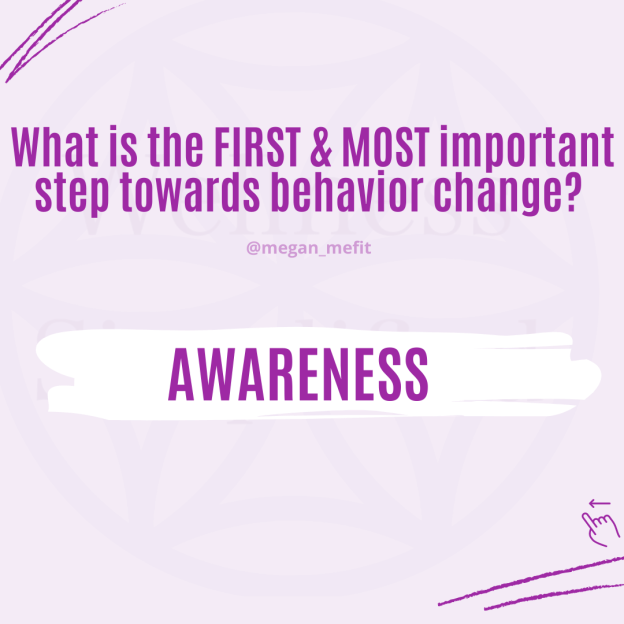
What is the FIRST and MOST IMPORTANT step in changing your behaviors?

Step ☝🏼 in cultivating change is awareness.

Awareness doesn’t equate to change though.

Cultivating self awareness around triggers, emotions, and self-limiting thoughts that lead to our behaviors is a very important part of the process. 🌀

🎯 Over time the target is to self manage the point of trigger before the behavior itself, “head off” our emotional chain reaction that leads to the unwanted behavior.

Awareness is the 🔑 that begins the ability to implement your intentions.

You have goals and desires, now you must bridge the gap to behaviors and actions.

Awareness is part of how you get there 💕

Link in bio to apply for coaching 🤍

#fitnesscoach#nutritioncoach#onlinepersonaltrainer#personaltrainer#mindsetiseverything#mindsetmatters#mindset#awareness#goals#newyorkfitness#hudsonvalleyny#westpointny#fitnessmotivation#awarenessiskey#awarenessispower
#behaviorchange#mindset#selfcompassion#healthylifestyle#healthyeating#health#healthiswealth#sustainablefitness#sustainablenutrition#trainertips

Benefits of Aloe Vera Juice

Aloe vera juice has many benefits, especially for gut health, but I think the most incredible thing is the amount of potassium it contains. There is 940mg in 8oz of juice! That’s even more than coconut water, making it an ideal option for optimal hydration. 

​Aloe vera juice is also beneficial for those that struggle with digestive issues. Aloe vera specifically helps to reduce inflammation in the digestive tract, which is helpful for acid reflux. It also helps pull water into the colon, which is why it aids in constipation and encourages regular bowel movements.

I get the Lakewood brand at my local Sprouts, but they also sell it at other grocery stores and Amazon! Comment below if you’ve ever tried it or are planning to.

It’s not sweet or particularly tasty on its own, but my favorite way to get my daily dose is in an adrenal cocktail. Just combine 4oz orange juice, 4oz aloe vera juice, and 1/4 tsp sea salt for a boost of vitamin C, potassium, and sodium. It’s delicious, energizing, and hydrating!

Reposted from

Women’s Health Dietitian

NutritionistAmanda Montalvo, RD, FDN-P

Do you REALLY need the candida cleanse?

  1. Is #candida overgrowth plaguing the population? 😲 👉🏼👉🏼
    I went to the experts @vitaminphd & @andreahardyrd to bring YOU the facts!🤝

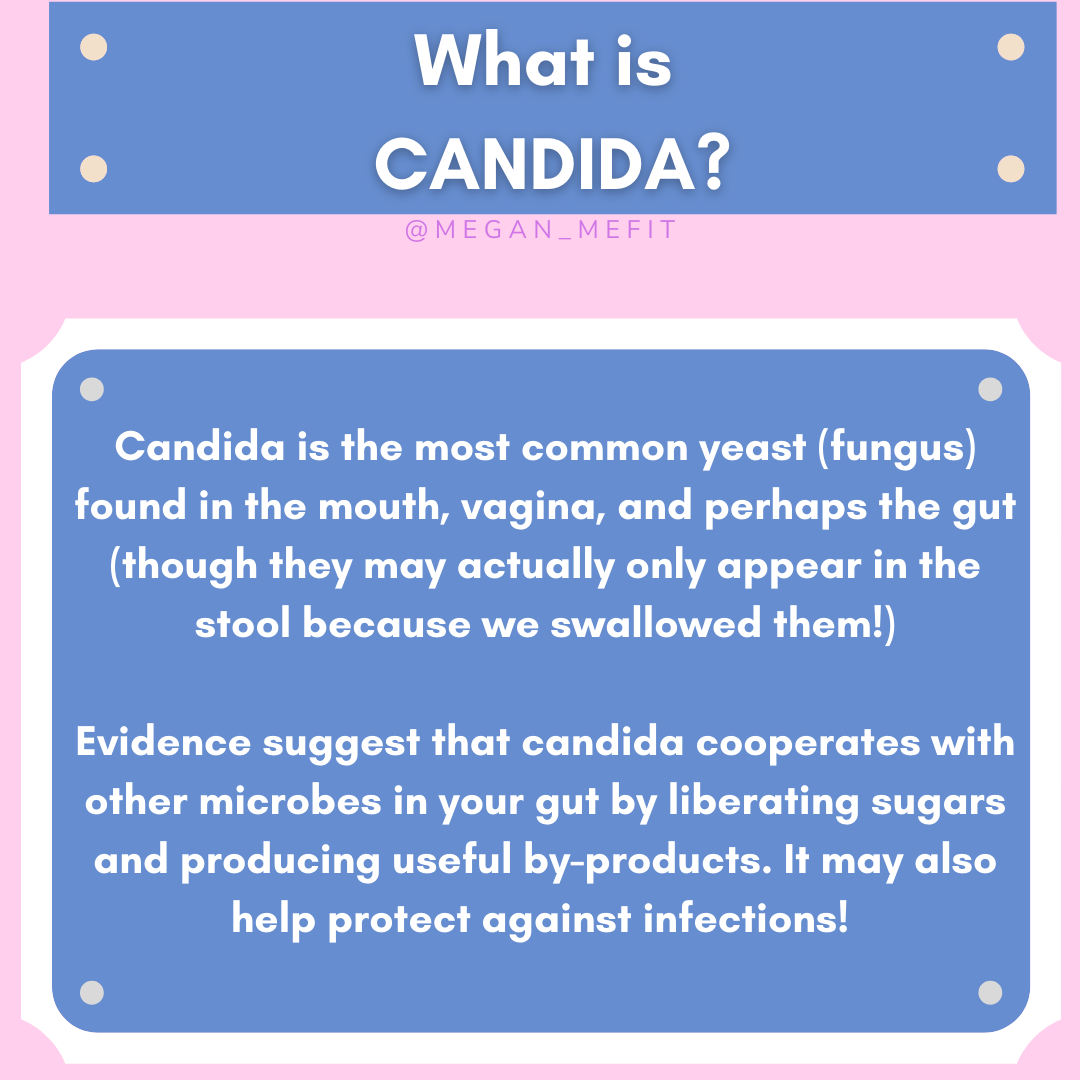
    Candida, or yeast is a fungus that naturally occurs all over our bodies – in our mouths, rectums, vaginas, and on our skin. It’s part of our ‘mycobome’ – (think microbiome but for fungus!)

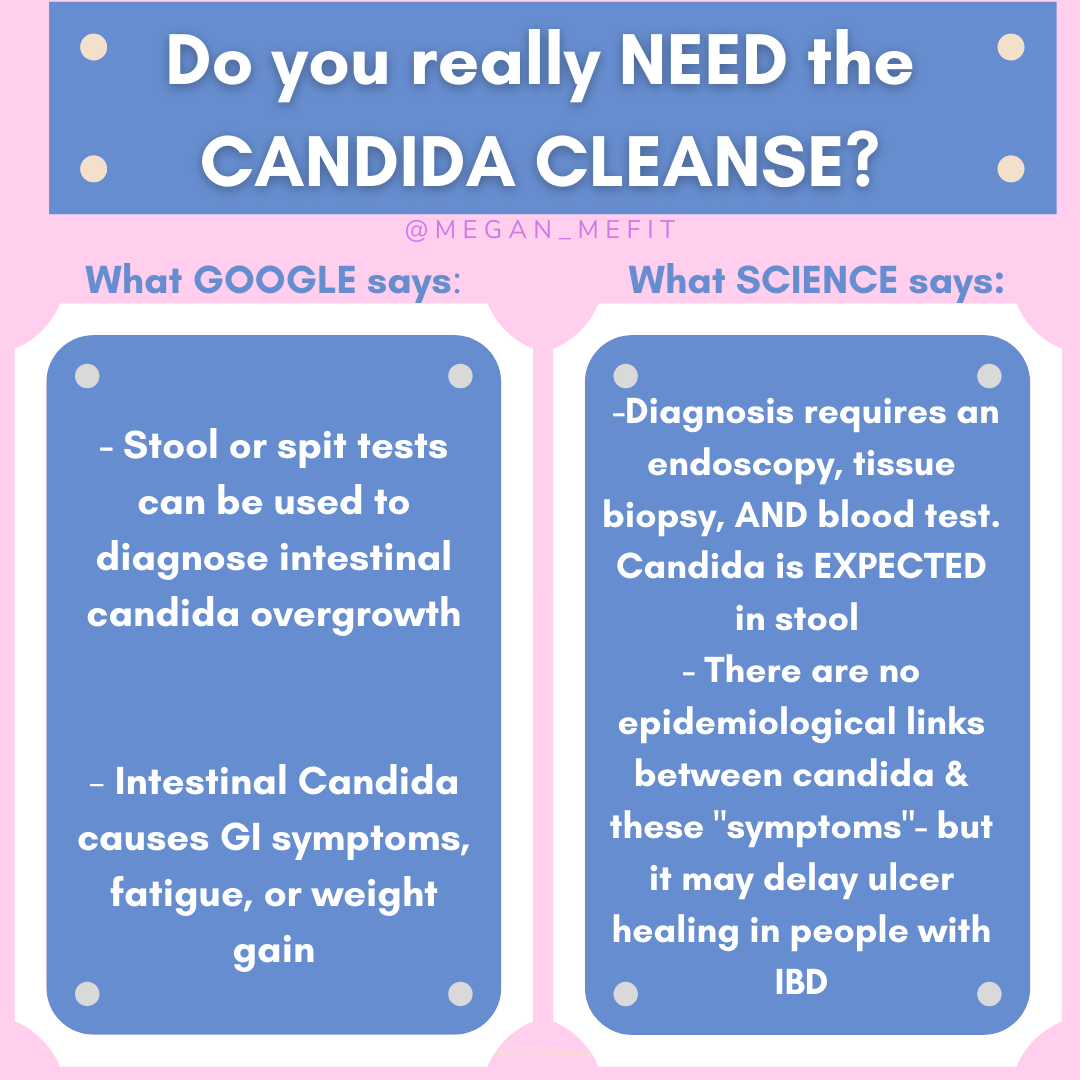
    While candida can be opportunistic, most of the time it exists in harmony with the rest of our microbes. However, there are practitioners quick to blame ‘candida overgrowth’ in anyone with gut symptoms, fatigue, and weight gain as the culprit. Followed by the prescription of dietary restrictions and a pile of supplements. But what are the facts?

    a spit test or stool test CANNOT diagnose candida – we would expect to find yeast there! Researchers are looking at small bowel cultures to diagnose fungal overgrowth in the gut, but so far, a higher level of yeast hasn’t always correlated with symptoms.

    dietary patterns do not appear to ‘cause’ candida! In fact, one well designed study found no association between refined carbohydrate intake and presence of candida.

    diet cannot ‘treat’ candida! While you might feel better on a diet lower in refined carbs, we need to ask ourselves, did improving diet quality account for symptom improvement?

    candidiasis can occur in the gut – but is typically seen in someone severely immunocompromised – for example undergoing cancer treatments or with HIV. Candidiasis needs to be treated with anti-fungals – not diet!

    many times, there are evidence based explanations for your symptoms – and ones that don’t require crazy restrictive diets. (hello – so many patients get ‘blamed’ for not following dietary protocols strictly enough and that’s why they’re not getting better? A more likely answer is, they didn’t have candida in the first place.)

    Bottom line: fungi makes up a normal part of your guts ecosystem. While it can be opportunistic, there has to be significant compromises to your gut and immune system to make space for yeast to grow. If anyone wants to do a spit or stool test to ‘diagnose’ candida or *gasp* does it based off a constellation of symptoms – you may want to question their approach. #onlinepersonaltrainer #personaltrainer #nutrition #nutritioncoach #cleanse #dietplan #diet #candida #candidadiet #detox #science #trainertips #explorepage #explore #evidencebased

How Clean Eating can be Damaging to Your Mindset and Health

One of the most common phrases I hear clients use when explaining their day-to-day food intake is “I eat clean.”

This phrase brings up may feelings for me. So, be prepared for a lengthy post.

The first is confusion, because what does it even mean to eat clean? and What foods are dirty? Also, the meaning varies from person to person. The second feeling is dismissal, because “clean” eating is a flawed trend of diet culture. I believe that as health and wellness professionals our nutritional guidance should be inclusive, keeping in mind cultural background, socioeconomic status, and psychological impacts of our recommendations and programming. Here, I will unpack the key flaws that I have encountered with the “clean” eating trend.

Socioeconomic Status

A recent study by Nutrition Today identified factors associated with low fruit and vegetable intake among low income families and individuals. The most common barriers were: lack of knowledge about healthy foods, lack of availability and access to fruits and vegetables, poor produce quality, and budget constraints. Health and fitness professionals likely mean well when recommending “clean” eating in their individual nutrition protocols or incorporating “clean” eating challenges into their group training programs. The barriers listed above, which are closely correlated with socioeconomic status and geographic location, may make “clean” eating an unrealistic or unachievable goal for the client.

“Cost of fruits and vegetables and income level are particularly influential on fruit and vegetable purchases, even more so than educational level, emphasizing the importance of budget when making fruit and vegetable purchases.”

Key Take Away: BUDGET MATTERS when making fruit and Veggie purchases.

With this new found understanding, I have completely changed how I communicate produce recommendations with my clients and in my social media content. I now understand that only a small fraction of the population can afford or even access organic foods. This is an example of socioeconomic privilege, so keep these barriers in mind when creating your programs or social media content.

I personally do care deeply about organic gardening and farming practices, and choose to buy organic when it is available, but I curate my nutrition recommendations through the lens of my clients.

White-Washing of Nutrition

Cultural foods should be considered when planning a nutrition protocol. “Clean” or “Healthy” Eating trends often demonize culturally significant foods by labelling them as “unhealthy.” An example I saw recently on in Instagram post instructed readers to “Eat less rice.” Further down the caption it classified Mexican food as “a cheat meal.” Nutrition advice should never criticize a client’s identity or culture. As coaches, we should be helping our clients understand nutrition while also making room to embrace their heritage. A sound nutrition program can be applied to family meal time, and should be all-inclusive. The meals will be good for the whole family*, and will result in a higher adherence rate by the client. (*Any specific and medically indicated meal plans that may not be suitable for the entire family should be started after consultation with an appropriate medical provider.)
⠀ ⠀⠀⠀⠀⠀⠀⁠⠀
All foods can fit a meal plan, and all cultures must fit; not as “cheat meals,”⁠ but as weekly staples that provide nourishment and connection.
⠀⠀⠀ ⠀⠀⠀⠀⠀⠀⁠⠀

Orthorexia: Obsession with Eating Foods Considered “Healthy”

Eating nutritious food is good, but if you have orthorexia, you obsess about it to a degree that can damage your overall well-being. Orthorexia is not an official diagnosis, but the basic idea is that it includes eating habits that reject a variety of foods for not being “pure” enough. Eventually, people with orthorexia begin to avoid whole meals that don’t meet their standards or that they don’t make themselves.

Signs You may Have Orthorexia

  • Worry about food quality. High levels of concern about the quality and source of foods you eat could lead to anxiety.
  • Avoid going out to eat, or avoid eating food prepared by others out of fear that foods you don’t prepare yourself won’t meet your standards.
  • Fear sickness — worry about how “clean” food is, or if it’s “bad” for your health.
  • Show physical signs of malnutrition. When you limit the variety of foods you eat, you may not get all the nourishment you need. You could lose weight as a result.
  • Bury yourself in food research. It’s one thing to spend a few minutes scanning a product label or surfing the web for more information on ingredients. But with orthorexia, you may spend hours thinking about food and planning meals.
  • Refuse to eat a broad range of foods. It’s normal to pass on some foods because you don’t like the way they taste or the way they make you feel. But with orthorexia, you might decide to drop whole categories of foods from your diet — grains, for example; or any foods with preservatives, gluten, or sugar; or all foods that just don’t seem “healthy”; or all of the above.
  • Fear losing control. You feel that you’re doing the right thing by eating healthy. But you may also be afraid that eating even one meal you didn’t prepare — including dinner at a restaurant — can be disastrous.
  • Be overly critical of your friends’ food choices. At the same time, you may have no rational explanation for your own.
  • Find yourself in a vicious circle. Your preoccupation with food causes you to bounce between self-love and guilt as you change and restrict your diet.

How Clean Eating is Damaging to Female Physiology

“Clean Eating” can mean different things to different people, but here are some of the most common “Clean” eating behaviors I see among women:⠀⠀⠀⠀

1. Avoiding red meat and eating mostly chicken.⠀⠀⠀⠀⠀⠀⠀⠀⠀
2. Subscribing to a low-carb or plant-based diet.⠀⠀⠀⠀⠀⠀⠀⠀⠀
3. Prioritizing raw veggies and salads.⠀⠀⠀⠀⠀⠀⠀⠀⠀
4. Snacking on nuts in excess.⠀⠀⠀⠀⠀⠀⠀⠀
5. Eliminating dairy, gluten, or sugar.⠀⠀⠀⠀⠀⠀⠀⠀⠀
⠀⠀⠀⠀⠀⠀⠀⠀⠀
Before you feel attacked, I have done ALL of these things. My goal is not to hurt feelings, but to convey the fallacy of “clean” eating-it is just another scam perpetuated by diet culture, and WILL wreak havoc on your hormones. Here’s why:⠀⠀⠀⠀⠀⠀⠀⠀⠀
⠀⠀⠀⠀⠀⠀⠀⠀⠀
👉Poultry does not contain the same density and multitude of nutrients found in red meat (i.e., B vitamins, iron, and zinc). Moreover, eating the same food on repeat can cause food sensitivity. Variety is always better!⠀⠀⠀⠀⠀⠀⠀⠀⠀
👉 Excessive raw vegetables in the diet can negatively impact thyroid function, causing suboptimal metabolism and slowed digestion.⠀⠀⠀⠀⠀⠀⠀⠀⠀
👉 Thyroid hormone conversion requires glucose, and low-carb diets take away the body’s preferred source of energy.⠀⠀⠀⠀⠀⠀⠀⠀⠀
👉 A plant-based diet lacks bioavailable vitamins, minerals, and protein; all are required to support healthy hormones. Sorry, don’t hate the messenger!⠀⠀⠀⠀⠀⠀⠀⠀⠀
👉 Nuts and seeds are difficult to digest and can irritate the gut. Polyunsaturated Fatty Acids (PUFAs) in general are anti-metabolic and can contribute to inflammation when eaten in excess.⠀⠀⠀⠀⠀⠀⠀⠀⠀
👉 Eliminating whole food groups = less nutrient variety and less food options that can result in food sensitivities! It can also lead to issues with food restriction behaviors that are stressful on the body. (Extra stress is never good!)

I believe using the phrase “clean eating” is a damaging part of diet culture influence and as health and wellness professionals, we can and should be providing sustainable nutrition protocols that are curated to the needs of each client and are culturally inclusive, and rooted in evidence-based science.

SOURCES:

Huang, Yancui MS; Edirisinghe, Indika PhD; Burton-Freeman, Britt M. PhD, MS Low-Income Shoppers and Fruit and Vegetables, Nutrition Today: 9/10 2016 – Volume 51 – Issue 5 – p 242-250
doi: 10.1097/NT.0000000000000176

Low-Income Shoppers and Fruit and Vegetables: What Do They T… : Nutrition Today (lww.com)

Orthorexia Nervosa: Signs & Treatment (webmd.com)

How clean eating is hurting your hormones-Women’s Health Dietitian Nutritionist Amanda Montalvo, RD, FDN-P

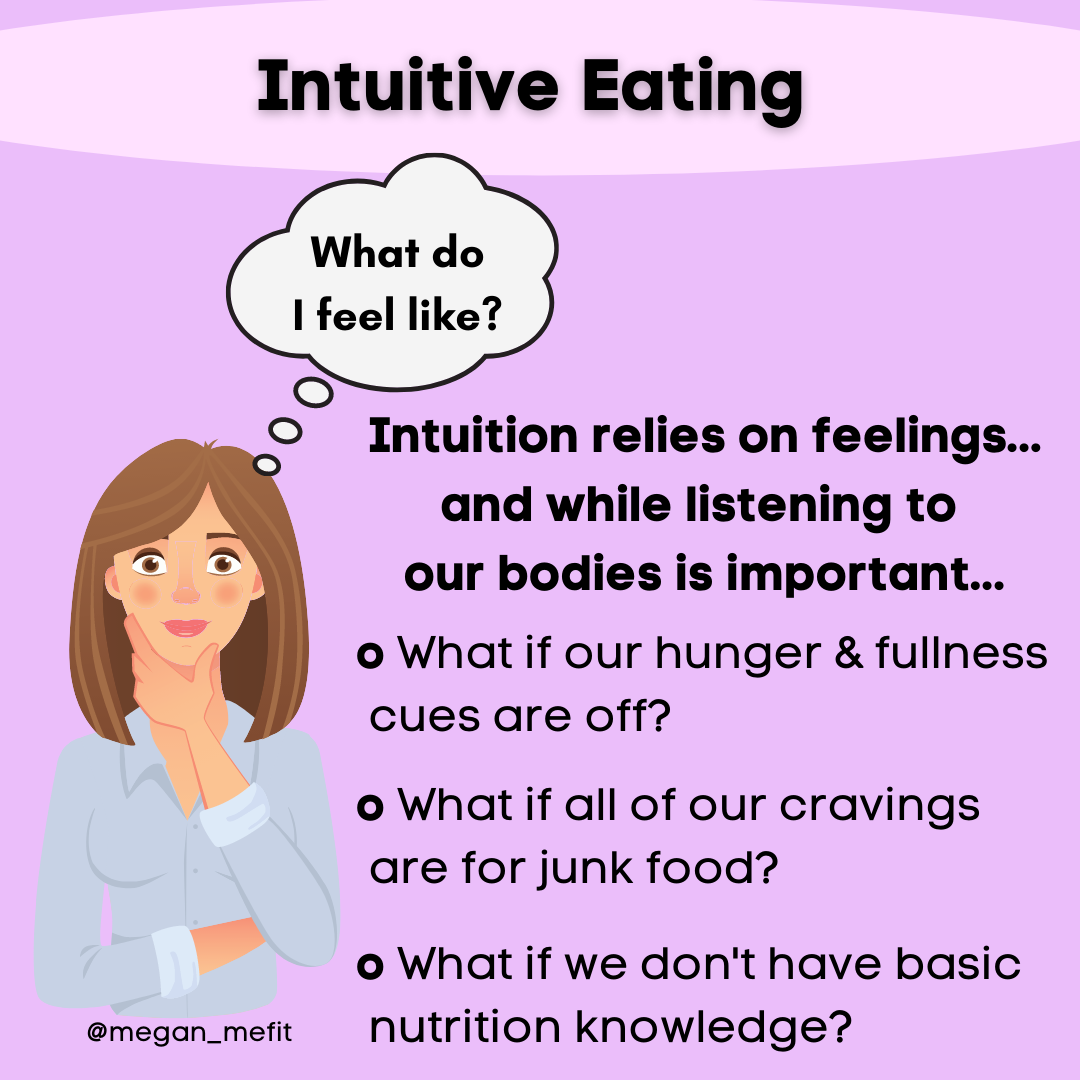
Intuitive Eating or Intentional Nourishment?

Intentional nourishment is one of the most fundamental aspects of my practice.

🙌🏼While listening to our bodies is HUGE, and listening to our feelings is an important part of mental health and healing.

⚠️What if your hunger and fullness cues are off? Most of my clients (and myself) do not always wake up hungry, or have sufficient appetites due to chronic stress & metabolic downregulation, therefore focusing on the MECHANICAL EATING side of things is important.

If you are sick? You still need to eat.
If you are stressed AF? You definitely need to eat.
Just not feeling hungry? You still need to nourish your cells.

⚠️What if we have never been taught to listen and trust our intuition? What if we have never listened or honored our biofeedback before?
What happens in times of weakness or doubt?
What prevents you from reaching out to a quick-fix diet or your old ways again?

⚠️ALL OF THESE questions are why I am not the biggest fan of intuitive eating, yet I believe the book and the principles are ground-breaking for yo-yo dieters and important to understand FOR SURE. 💯

💜Nourishing with intention takes intuitive eating much deeper, it is a fusion of body, brain and feelings. It’s creating and maintaining a balance amongst knowledge, hunger cues, feelings and cravings.

💜Practicing nourishing with intention until you find your balance and can trust your body again.

🥰Join my FB group for more support 🌀Wellness Simplified🌀 | Facebook

Emotions & Responses Cheat Sheet

For all emotions, remember:

  1. Feelings will not hurt you, even if they are uncomfortable, they are not dangerous.
  2. They are always temporary.
  3. It’s okay to feel the way you do- you don’t need a reason.
  4. it’s safe for other people to have feelings too.

Sad/Lonely

  • Talk or call someone
  • Write a letter or email
  • Read, listen to music

Frustrated

  • Adjust your expectations
  • Take a break
  • Deep breaths, seek patience

Fatigued

  • Slow your pace (not quit)
  • Take a nap or lay down
  • Head to bed early

Overworked

  • Do something you enjoy
  • Do the chores tomorrow
  • Plan a break

Angry

  • Cool down before acting
  • Assume positive intent
  • Listen and communicate

Overwhelmed

  • Get organized
  • Hire a pro where you can
  • Take on thing at a time

If you are thinking about food all day, it’s not a willpower issue. It’s a RESTRICTION issue.

One of the questions within my coaching program in the weekly-check in form: “How is your hunger? Are you constantly thinking about food? Do you feel hunger and fullness cues throughout the day? “

I ask this question because: When your body is properly FED, so is your mind.☺️

I will never forget how it felt to restrict myself.

Not just of food…of fun experiences, I will never, get back.

I will never forget HOW STRESSED I would be, if I’d be gone from the house for any length of time and I didn’t have food with me. Most of the time, I’d pack my lunch box and be eating cold chicken and asparagus out of plastic containers no matter where I went.

I’ll never forget, when I was following a strict meal plan, told to eat 6 small meals per day, & having to set a timer for 2.5 hours, to allow myself to eat again. My meals were SO SMALL ~250 calories, I’d be so hungry, I’d have to force myself to wait until it was time to eat again. (this is NOT okay)

I will never forget thinking ‘I can’t wait for that one moment where I can eat a burger…for my re-feed, because I earned it for all the work I have done’.

They said:
“Your body is #goals!”
“I wish I could be like you! How do you do it?”

I was celebrated for depriving myself, I got in stage in a tiny bikini & won trophies for this “willpower”. 🏆

I was so wrong.

I was starving.

Your body is smart. It KNOWS when you are underfed & overdoing it. You cannot outsmart it, no matter what you do.

For many people, a yearning for food, longing for that next meal & daydreaming about food, is not a sign of a lack of ‘willpower’ or a mindset issue.

It’s your body screaming at you to feed it.

When we are properly fueled, it has a beautiful in flow effect throughout our entire system…& that includes your mind.

Imagine CLARITY about what you actually WANT & NEED to eat.

Imagine FOCUS on life outside of your next meal.

Imagine achieving BALANCE, not because your TOLD you must, but because your body TELLS you itself.

And the only way to get there, is to stop restricting and start nourishing.